Horizontal vs Vertical Fences: What Cypress Homeowners Prefer in 2026

When most homeowners start shopping for a new fence, they usually focus on how it looks.
And that’s understandable.
A fence is one of the first things people notice about your property. It affects privacy, curb appeal, security, and even property value.
But after years of Texas heat, humidity, heavy rain, and storms, appearance becomes only part of the equation.
The real question is:
Which material is actually going to hold up best in Cypress?
For most homeowners, the decision comes down to two popular options:
Both have advantages.
Both have drawbacks.
And both perform differently in Southeast Texas conditions.
Let’s break down what homeowners should know before making a decision.
A fence that performs well in another state may not perform the same way here.
Cypress homeowners deal with:
According to the National Weather Service, Southeast Texas regularly experiences extreme weather conditions that can affect outdoor structures over time.
That means choosing the right fence material is not just about style.
It is about long term durability.
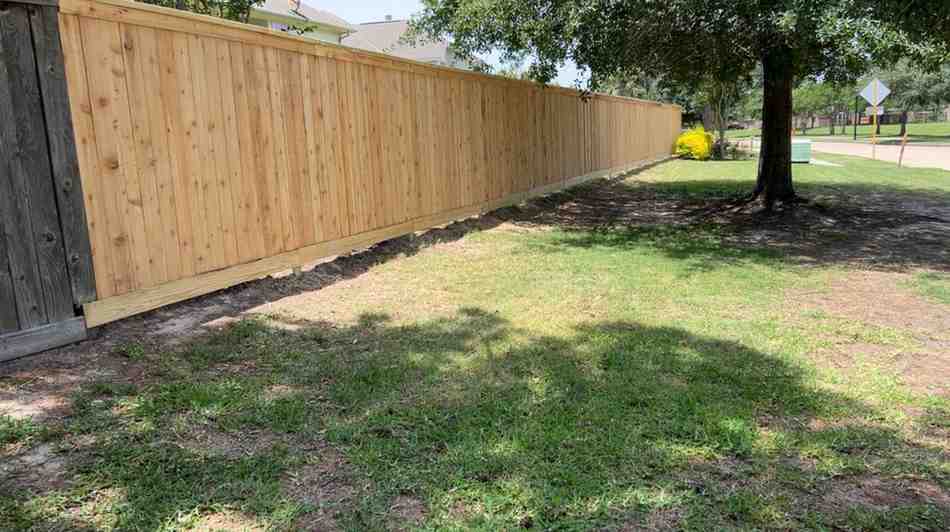
Wood continues to be the most common fence choice throughout Cypress neighborhoods.
There are several reasons why.
Many homeowners simply prefer the traditional look of wood.
It blends well with:
Wood has a warmth and character that many people feel vinyl cannot fully replicate.
Wood privacy fences remain one of the best solutions for homeowners who want:
A properly installed wood fence creates a solid barrier that many homeowners appreciate.
Wood fencing is often more affordable upfront.
For many families, this makes it an attractive option when budgeting for a new fence project.
If cost is a major factor, wood frequently comes out ahead during the initial estimate process.
While wood has many strengths, it is not maintenance free.
Texas sun is relentless.
Over time, UV exposure can cause:
Without proper care, wood can begin showing wear sooner than expected.
Humidity creates another challenge.
Wood naturally absorbs and releases moisture.
This can lead to:
Especially if the fence is not regularly maintained.
Most wood fences require periodic:
Many homeowners do not mind this.
Others prefer something lower maintenance.
Vinyl fencing has grown significantly in popularity over the last several years.
Many Cypress homeowners are attracted to its simplicity.
One of the biggest advantages of vinyl is how little maintenance it requires.
There is no need for:
Most of the time, a simple cleaning is enough to keep it looking good.
Unlike wood, vinyl does not absorb water.
That means:
This can be a major advantage in humid climates like Southeast Texas.
Vinyl tends to maintain its appearance for years.
Many homeowners appreciate that it continues looking clean and consistent with minimal effort.
Vinyl is not perfect.
There are some drawbacks homeowners should understand.
The biggest hurdle is usually cost.
Vinyl fencing often costs more upfront than wood.
While some homeowners recover that cost through reduced maintenance, the initial investment can be higher.
Extreme temperatures can cause vinyl to expand and contract.
High quality installation helps account for this movement.
Poor installation, however, can create issues over time.
Some homeowners simply prefer the natural look of wood.
While vinyl technology has improved significantly, personal preference still plays a major role.
Generally speaking:
Approximately 10 to 15 years with proper maintenance.
Often 20 years or longer with minimal maintenance.
Actual lifespan depends heavily on:
When it comes specifically to heat and humidity:
Vinyl generally has the advantage.
Because it does not absorb moisture and does not require staining or sealing, it tends to handle weather exposure more consistently.
However, a properly maintained wood fence can still perform very well for many years.
The key is understanding the maintenance commitment involved.
This depends on your goals.
Neither option is universally better.
The right choice depends on your property and priorities.
This is something homeowners often overlook.
The truth is:
A properly installed wood fence will outperform a poorly installed vinyl fence.
And a properly installed vinyl fence will outperform a poorly installed wood fence.
Post depth, concrete support, spacing, and drainage all matter.
Especially in Cypress where soil movement is common.
This is why professional installation matters just as much as material selection.
If you are exploring options, our fence installation services page explains how proper installation affects long term performance.
Generally yes, wood usually costs less upfront.
High quality vinyl is designed to handle temperature changes when properly installed.
Vinyl requires significantly less maintenance.
Both wood and vinyl can add value depending on neighborhood expectations and condition.
Vinyl typically lasts longer with less maintenance.
There is no universal winner.
The best fence for your property depends on:
For some homeowners, the traditional beauty of wood is worth the maintenance.
For others, the convenience and durability of vinyl make it the obvious choice.
The important thing is choosing a fence that fits both your property and your lifestyle.
If you are comparing fence materials and trying to determine what makes the most sense for your property, it helps to work with professionals who understand local conditions.
Learn more through our fence installation services or explore repair solutions through our fence repair services if your current fence still has life left in it.